Software & Resources

Sharing code and data

Sharing codes and know-how is what really makes science move fast. Together with collaborators, I develop statistical software, mostly in R, to make similar analyses easier for other researchers, and I share data and materials from published studies for replication.

R packages

R package

crqa: Cross-Recurrence Quantification Analysis

Cross-recurrence quantification analysis of two time-series, categorical or continuous. Provides diagonal-recurrence profiling as well as deeper measures of the whole cross-recurrence plot, such as recurrence rate. Introduced in Coco & Dale (2014, Frontiers in Psychology) and extended in Coco et al. (2021, The R-Journal).

R package

mousetrack: Mouse-Tracking Measures from Trajectory Data

Extracts dependent measures from two-dimensional x–y coordinates of an arm-reaching trajectory: area under the curve, latency to start the movement, x-flips and more, characterising the action-dynamics of a response. Built mainly for mouse-tracking experiments.
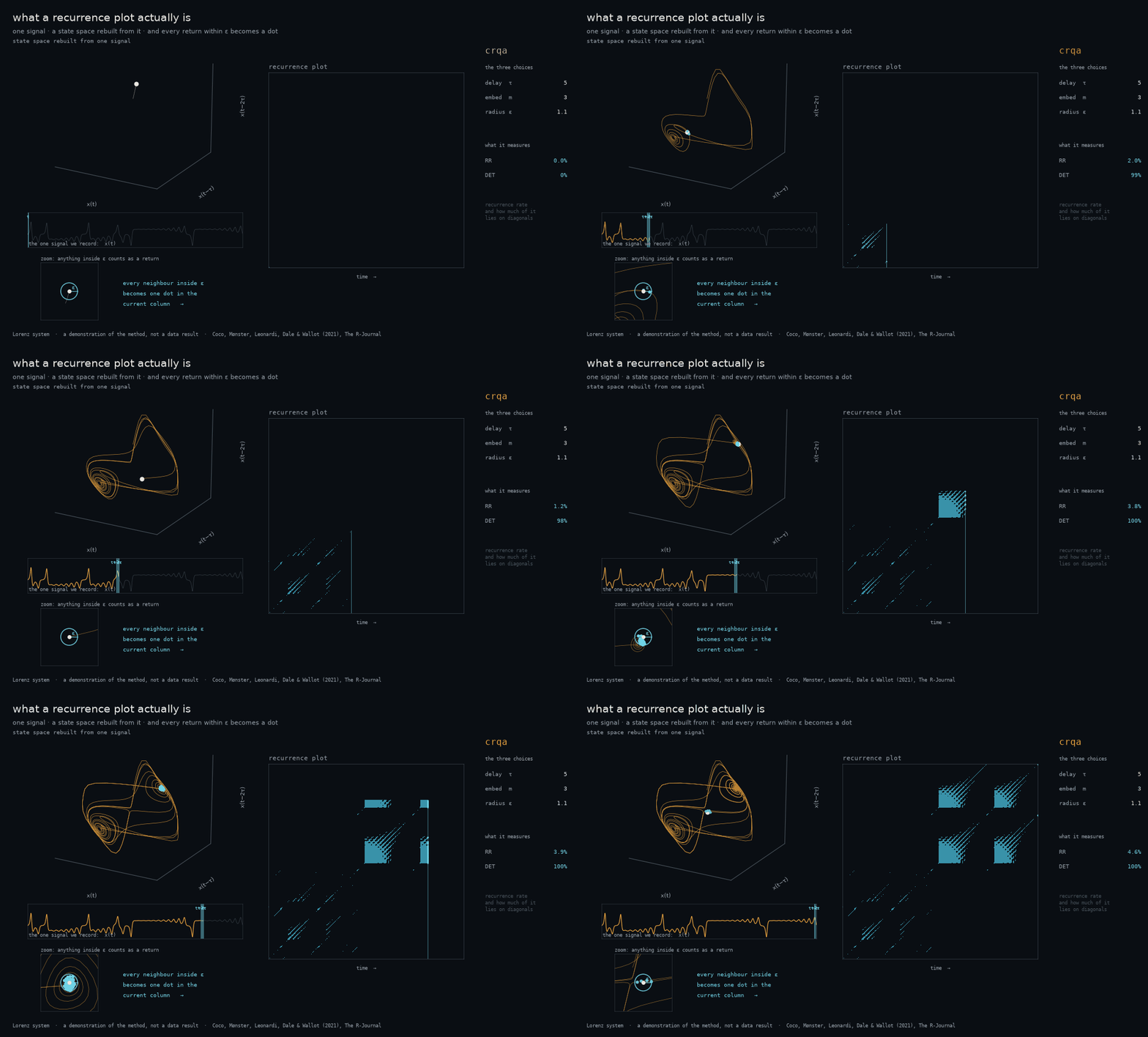
A three-panel animation. On the left, a state space reconstructed from a single signal by delay embedding, with the Lorenz attractor's two lobes visible and the current state's neighbours highlighted. Below it the raw signal with the delay taps marked, and a zoom inset showing the radius epsilon as a circle around the current state. On the right, a recurrence plot filling in over time, with the current column lit to show that each neighbour inside the radius becomes one dot.
what a recurrence plot actually is: one signal, a state space rebuilt from it by delay embedding, and every return within radius ε becoming a dot. A demonstration of the method on the Lorenz system, not a data result · Coco, Mønster, Leonardi, Dale & Wallot (2021), The R-Journal

Data & materials

Explaining and replicating are core principles of science. In the interest of sharing experimental data and methodology for broader interrogation, here is data and stimulus material from selected published studies.

VISIONS database

165 indoor scenes in which the same location holds either a consistent or an inconsistent object, across left/right positions, normed for name agreement, conceptual and perceptual properties (clarity, confidence, prototypicality, familiarity, manipulability, visual complexity) and accompanied by free-viewing eye-tracking data. Allegretti, D'Innocenzo & Coco, Behavior Research Methods (2025). DOI

Scan patterns predict sentence production

Coco & Keller, Cognitive Science 2012: responses across modalities are similarly coordinated by scan patterns. This paper was featured in New Scientist and BBC Mundo.

Classification of visual and linguistic tasks using eye-movement features

Coco & Keller, Journal of Vision, 2014, 14(3):11. Eye-movement features can accurately classify the task from which responses were collected. DOI